
Sitting is Not the Enemy, Stagnation Is: The Power of Variable Posture
For years, the fitness world has hammered home a terrifying message: "Sitting is the new smoking." It’s a catchy headline, but as a movement specialist, I’m here to tell you that it’s a bit of an oversimplification. The chair itself isn't a toxic object, and sitting isn't inherently "evil."
The real villain in the room is stagnation.
Our bodies are masterpieces of adaptation. They are designed to climb, squat, reach, and twist. When we sit in a singular, static position for eight hours a day, our tissues adapt to that stillness. Your hip flexors shorten, your upper back stiffens into a rounded "C" shape, and your glutes—the powerhouses of your lower body—effectively go to sleep.
The antidote isn't necessarily standing all day (which brings its own set of static stresses). The antidote is movement variability. To keep your joints juicy and your nervous system happy, you need to change the "load" on your tissues.
Here is how to break the cycle of stagnation by integrating variable positions into your workday.
The Power of the Half-Kneeling Position
If you have the floor space (or a cushion/yoga block), the half-kneeling position is a game-changer for desk workers. By dropping one knee to the floor and keeping the other foot planted in front of you, you immediately accomplish two things:
Passive Hip Opening: You are putting the hip flexor of the trailing leg into a gentle stretch, counteracting the "shortening" that happens while seated.
Core Engagement: Staying upright in this position requires subtle stability from your trunk and glutes.
Try taking a five-minute phone call in a half-kneeling position, switching legs halfway through. It transitions your body from a "collapsed" state to an "active" one without you even having to break your workflow.
Transitioning to Standing (The Right Way)
Standing desks are great, but many people make the mistake of standing perfectly still, locked at the knees. This just replaces one form of stagnation with another.
When you stand to work, think about dynamic standing. Shift your weight from left to right. Place one foot on a small stool or a thick book (the "Captain Morgan" pose) to tilt your pelvis and relieve lower back pressure. Every 20 minutes, perform a few "calf raises" or a "standing desk cat-cow" by placing your hands on your desk and arching/rounding your back.
The 30-Minute Rule
The goal isn't to find the "perfect" posture; it’s to ensure your next posture is different from your last. I recommend the 30-Minute Shuffle:
30 Minutes: Seated (with good lumbar support).
30 Minutes: Standing (moving your weight around).
5 Minutes: Half-kneeling or a deep "bi-pedal" squat.
By treating your workday as a series of movement opportunities rather than a sentence to stillness, you stop fighting against your chair and start working with your biology. Remember: your best posture is your next posture.
Common Questions About Movement & Stagnation
Q: I have a standing desk, but my feet and back still hurt. Why?
A: Standing is only half the battle! If you stand perfectly still for four hours, you’ve simply swapped "seated stagnation" for "standing stagnation." Your body still experiences static loading. The key is to move while you stand—shift your weight, use a footrest to change your pelvic angle, or take "micro-walks" every 20 minutes.
Q: How often should I actually change positions?
A: A good rule of thumb is the 30/30/2 rule. Try to spend 30 minutes sitting, 30 minutes standing, and at least 2 minutes moving or stretching. You don't have to be a clock-watcher, but if you feel that "stiff" sensation, you’ve already stayed in one spot too long.
Q: Is the half-kneeling position okay if I have bad knees?
A: Great question. If you have knee sensitivity, use a thick garden kneeler, a folded yoga mat, or a pillow. If kneeling on the floor is a "no-go" for you, you can achieve a similar hip-opening effect by doing a standing lunge with your back foot elevated on a low step.
Q: I’m in an open office. Won’t I look weird doing half-kneeling at my desk?
A: It might feel that way at first, but you’d be surprised how many people will actually ask you why you’re doing it because they’re in pain, too! If you're shy, start with the "Captain Morgan" standing pose or seated spinal twists. Usually, once people see the energy boost you get from moving, they’ll be asking you for tips.
Q: Does "movement" have to be a full workout?
A: Not at all. In fact, for longevity and pain management, these "movement snacks" are often more important than a one-hour gym session. We are looking for frequent, low-intensity inputs to tell your nervous system that it’s safe to stay mobile and limber.
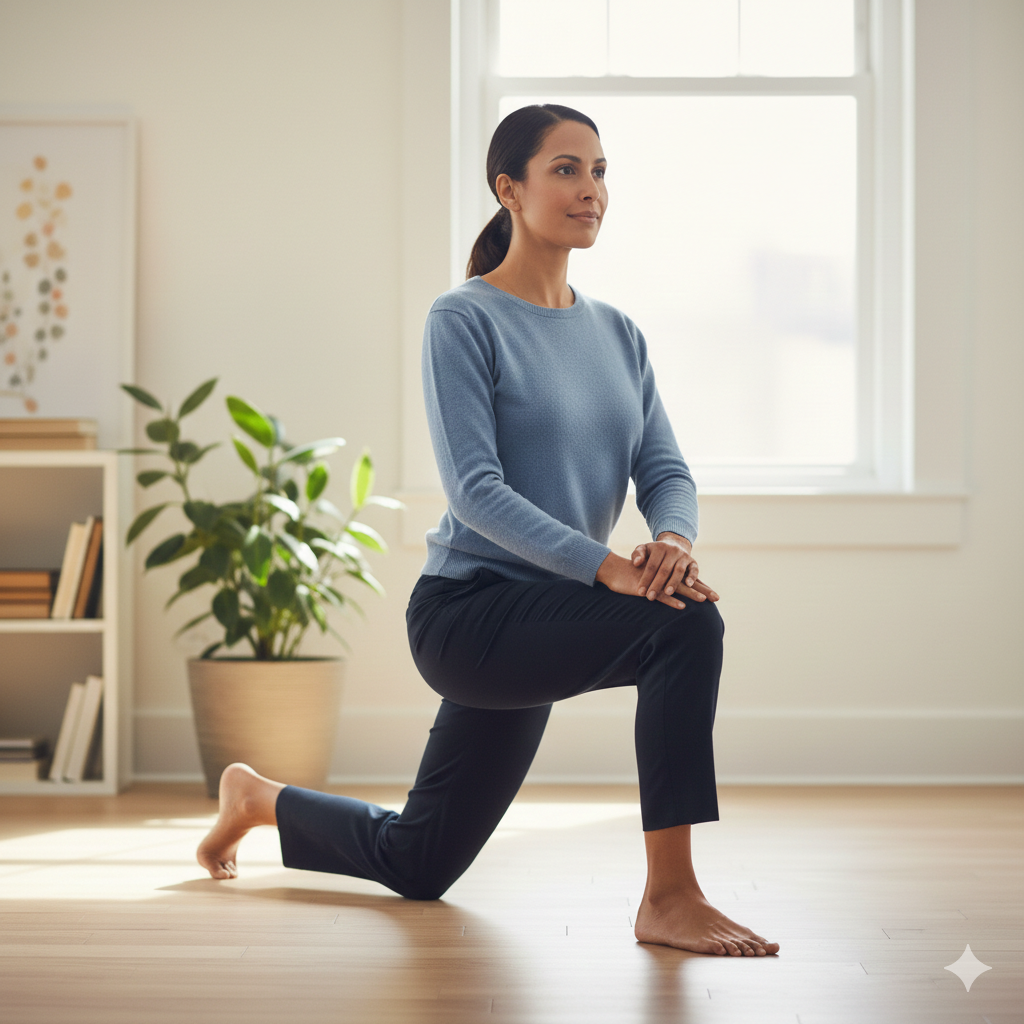
Half kneeling position is great for opening the hip up on the back leg, plus works your stability.
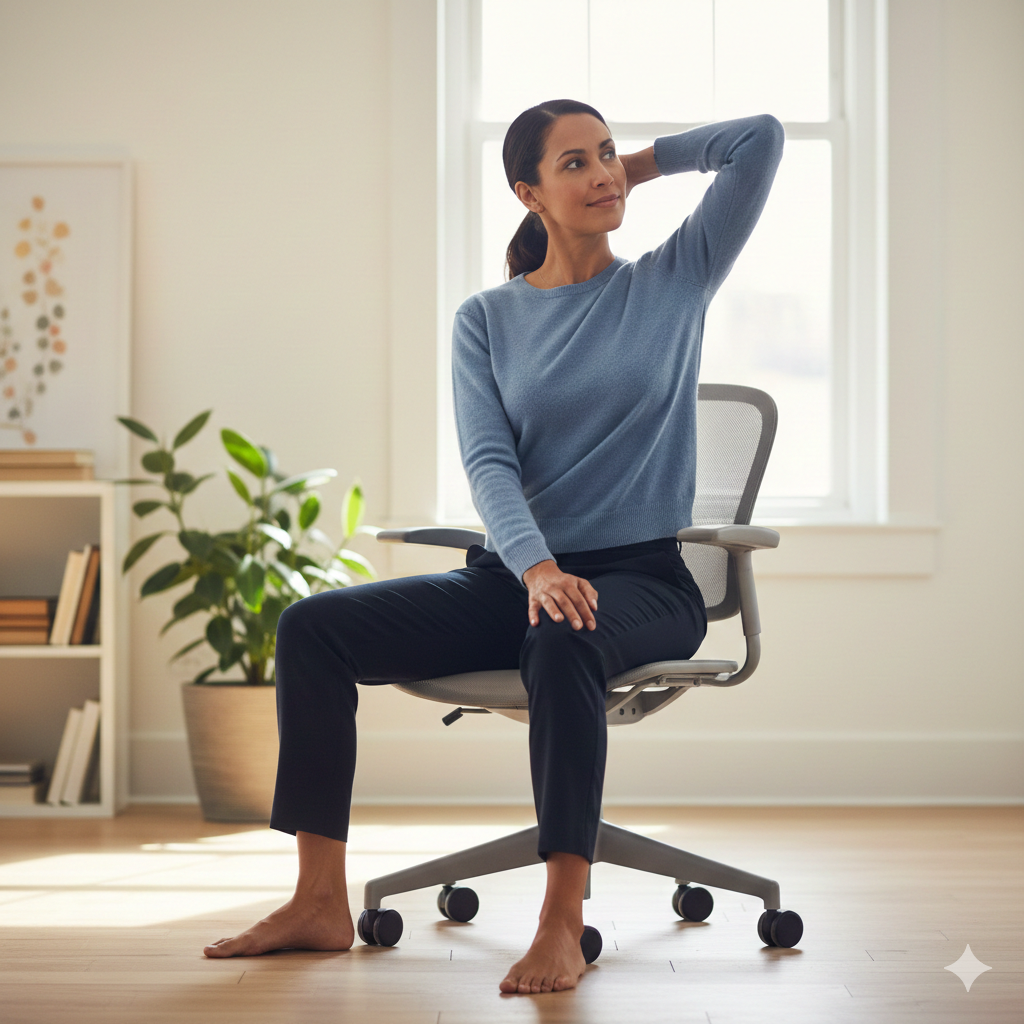
Adding simple rotation exercises whilst sitting can also help.