
The Case for Strength: Why Lifting Weights is the Ultimate Longevity Strategy
In our culture, we have a strange relationship with ageing. We tend to view the "slowing down" process—the creaky knees, the rounding of the back, the loss of balance—as an inevitable slide that we just have to accept. We’re told to "take it easy" as the birthdays pile up.
I’m here to tell you that the opposite is true. The older we get, the more "difficult" things we should be doing.
If there is one single intervention that can radically transform how you age, prevent injury, and counteract the corrosive effects of a desk-bound job, it isn't yoga, it isn't jogging, and it isn't a "detox." It is progressive strength training.
Strength isn't about the size of your biceps or how you look in a vest on Portobello beach. It’s about building a body that is "hard to break."
1. The Sitting Tax: Reversing the Desk Job Decline
If you work a typical UK office job, you are likely sitting for 8 to 10 hours a day. We’ve discussed before how this "molds" your hips into a seated position, but the damage goes deeper.
Prolonged sitting causes Sarcopenia (the natural loss of muscle mass) to accelerate. When you don't use your muscles to move heavy loads, your body—being the ultimate efficiency machine—decides it doesn't need to spend the energy maintaining that muscle. It "prunes" it away.
By the time you reach your 40s and 50s, if you haven't been strength training, you are operating on a significantly reduced "engine." This is why things that used to feel easy, like carrying four bags of shopping from the car or digging in the garden, suddenly start to feel like a monumental effort.
Strength training is how you pay back the "sitting tax." It forces your nervous system to wake up and reminds your body that it needs to stay robust, regardless of how many hours you spend behind a laptop.
2. Armour Building: The Secret to Injury Prevention
Most people think lifting weights causes injury. In reality, being weak is a much higher risk factor for getting hurt.
Think of your muscles as the "shock absorbers" for your joints. When you have adequate strength in your glutes, hamstrings, and core, they take the brunt of the force when you trip on a kerb, lift a heavy box, or play a game of five-a-side football.
When those muscles are weak, that force doesn't just disappear. It travels directly into your passive structures: your intervertebral discs, your tendons, and your ligaments. This is where "slipped discs" and "dodgy knees" come from.
Strength training builds "Structural Integrity." It thickens your tendons and increases bone density (crucial for warding off Osteoporosis). It essentially builds a suit of biological armour that protects your skeleton from the rigours of daily life.
3. Healthspan vs. Lifespan: Adding Life to Your Years
In the UK, our "Lifespan" (how long we live) has increased significantly thanks to modern medicine. However, our "Healthspan" (how long we live in good health) hasn't kept pace. Many people spend the last 15 to 20 years of their lives in a state of physical frailty, unable to get up from a chair without help or play with their grandchildren on the floor.
Strength is the primary predictor of functional independence. Research consistently shows that grip strength and leg power are some of the strongest markers for all-cause mortality. Why? Because a strong body is a resilient body. If a strong person falls, they are less likely to break a hip. If they get a respiratory infection, they have more metabolic reserve to fight it off.
Lifting weights is an investment in your "future self." You aren't just training for today; you are training so that at 85, you can still walk up the stairs, carry your own suitcase, and live life on your own terms.
4. The Metabolic Engine
Beyond the muscles and bones, strength training is a metabolic powerhouse. Muscle is "expensive" tissue; it requires a lot of energy to maintain. By increasing your muscle mass, you improve your Insulin Sensitivity. In a country where Type 2 Diabetes and metabolic syndrome are on the rise, having a "sink" for glucose (your muscles) is one of the best ways to protect your long-term health. It helps regulate your weight, improves your sleep quality, and even has profound effects on cognitive health and brain function as we age.
5. How to Start (It's Never Too Late)
The most common excuse I hear is, "I'm too old to start lifting weights."
The science says otherwise. Studies have shown that even individuals in their 90s can see significant gains in muscle size and bone density from a supervised strength programme. Your body never loses the ability to adapt; it just waits for the stimulus.
If you are new to this, or returning after a long break, here is the roadmap:
Focus on Compound Movements
Don't worry about "bicep curls." Focus on the big human movements:
The Squat: Sitting down and standing up.
The Hinge: Picking something up from the floor (Deadlifts).
The Push/Pull: Pushing a door open or pulling a heavy rower.
The Carry: Carrying heavy items over distance (Farmer’s Walks).
Prioritise Form Over Load
At the start, the weight on the bar doesn't matter. The "quality" of the movement does. This is where working with a specialist is invaluable—learning to move correctly ensures the stress goes to your muscles, not your joints.
Consistency Trumps Intensity
You don't need to spend two hours in the gym. Two or three 45-minute sessions a week is plenty to see life-changing results, provided you stay consistent.
The Bottom Line: Strength is Freedom
As we age, the world tends to get "smaller" for people who are weak. They stop travelling because the walks are too long; they stop socialising because the stairs are too steep.
Strength training keeps your world large. It gives you the physical freedom to say "yes" to life’s adventures. Whether you are 35 or 75, the best time to start building your foundation was yesterday. The second best time is today.
Q&A: Strength Training & Longevity
Q: Am I too old to start lifting weights? A: Never. Research has shown that even individuals in their 90s can increase muscle mass and bone density through resistance training. The body never loses its ability to adapt to a stimulus; it just requires a programme tailored to your current starting point. The goal isn't to become a bodybuilder; it’s to improve your "functional ceiling" so daily life feels easier.
Q: Won’t lifting heavy weights hurt my joints or my back? A: Actually, being weak is often what hurts your joints. When muscles are strong, they act as shock absorbers. When they are weak, that force is transferred directly to your joints and spine. The key is progressive overload—starting with movements you can manage with perfect form and gradually increasing the challenge. Strength training, done correctly, is one of the best treatments for chronic joint pain.
Q: I already do a lot of cardio (running/cycling). Do I still need to strength train? A: Yes. While cardio is brilliant for your heart and lungs, it doesn't do much to prevent age-related muscle loss (sarcopenia) or bone density decline. In fact, excessive cardio without strength training can sometimes lead to overuse injuries because the "engine" (the heart) is stronger than the "chassis" (the muscles and joints). Think of strength training as the structural maintenance that allows you to keep running or cycling for longer.
Q: How often do I need to train to see results? A: You don’t need to live in the gym. For most people, two to three 45-minute sessions per week are sufficient to build significant strength and bone density. Consistency is far more important than intensity. It’s better to train twice a week every week than to train five times a week for a month and then quit.
Q: Do I need to go to a gym, or can I train at home? A: You can certainly start at home with bodyweight exercises (squats, lunges, press-ups) or resistance bands. however, to keep seeing results as you get stronger, you eventually need to add external weight—like kettlebells, dumbbells, or barbells. A gym provides the variety of equipment needed to keep challenging your muscles as they adapt.
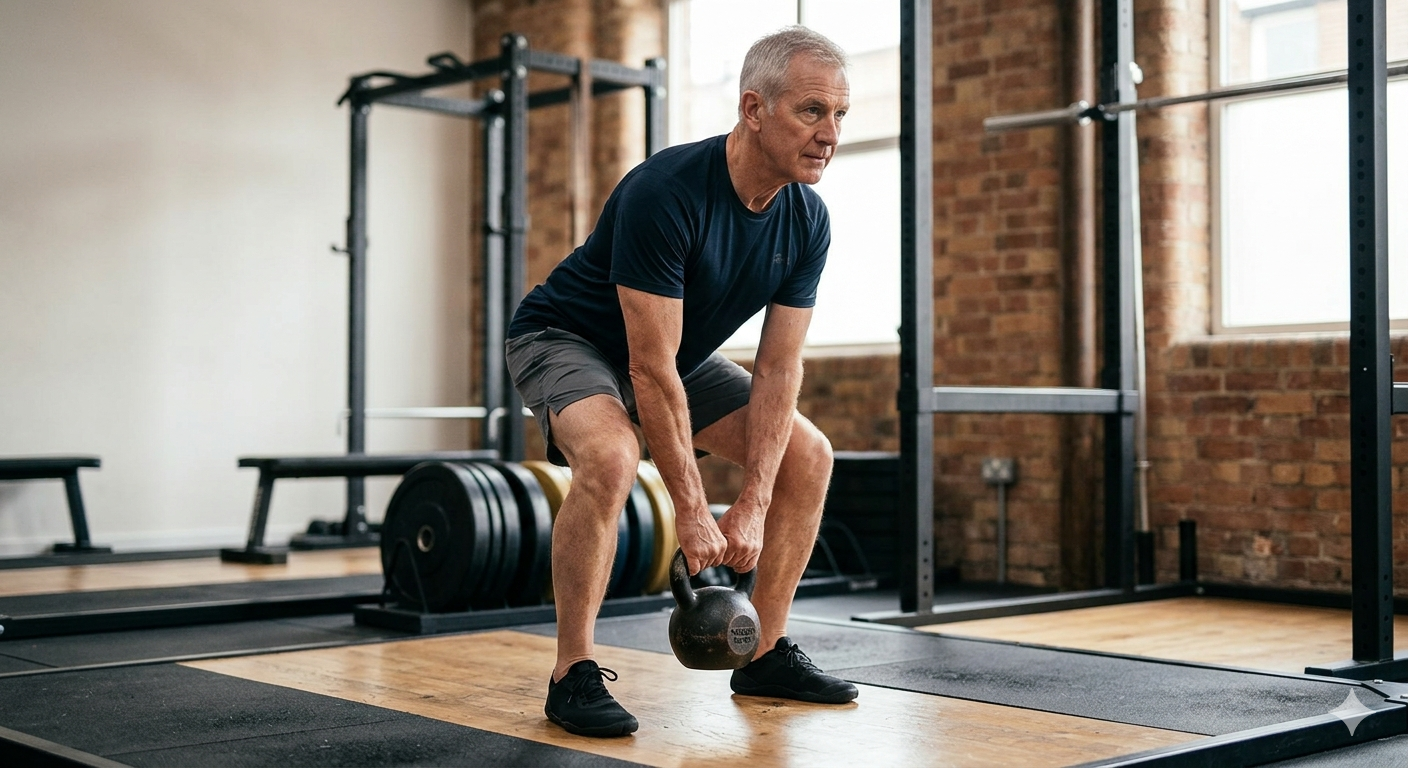
A man in his 70’s, performing a Kettlebell Deadlift.