The 6-Hour Rule: Why Walking is the Key to Healthy Hips
In our modern, convenience-driven world, we’ve made a dangerous trade. We’ve traded movement for comfort, and our hips are paying the price.
As someone who spends their day analysing human mechanics, I see the same pattern over and over again: tight hip flexors, "glute amnesia" (butt muscles that have forgotten how to fire), and a nagging lower back grumble.
We try to fix these issues with a 15-minute stretching routine or by smashing out a 45-minute HIIT class a few times a week at the local gym. But here is the hard truth that many UK fitness programmes miss: You cannot out-train a sedentary lifestyle.
Your hips are designed for massive amounts of low-grade, varied movement. To remain truly healthy, mobile, and pain-free, current biomechanical thinking suggests your hips should be in motion for roughly six hours a day.
Before you panic—no, this doesn't mean six hours on a treadmill. It means reclaiming the most fundamental human skill: Walking.
The Hip: Use It or Lose It
The hip joint is a ball-and-socket masterpiece. It’s built for a huge range of motion—rotation, flexion (lifting your knee), extension (pushing your leg back), and abduction (moving your leg out to the side).
However, the vast majority of us, particularly those in office-based roles, spend our days with our hips locked at 90 degrees in a seated position.
When you sit, the muscles at the front of your hip (the hip flexors) shorten and tighten. Your glutes, which are supposed to support your lower back, go "offline." Worst of all, the joint capsule itself begins to stiffen from lack of use. Over years of this "sitting-itis," your body literally "molds" itself into the shape of your chair.
Walking is the direct, powerful antidote to this "chair-shape." Every step you take is a dynamic stretch for the front of your hip and a functional contraction for your glutes. When you walk, you are "flossing" the joint, keeping the cartilage lubricated and the surrounding tissues supple.
Why 6 Hours?
Think of movement like nutrition. A 1-hour gym session is like taking a high-dose vitamin pill—it’s concentrated, intense, and useful. But walking is like your "macro-nutrients"—the proteins, fats, and carbs that sustain your everyday life. You can’t survive on vitamins alone, and your hips can’t survive on gym sessions alone.
Evolutionarily, humans were persistence hunters and gatherers. We didn't spend 8 hours sitting and then 1 hour sprinting; we spent the entire day on our feet, moving at a varied pace. Our lymphatic system, our circulation, and our joint health are all predicated on this constant "pumping" action of our leg muscles.
The "6 hours" isn't a strict target for a single walk. It’s the cumulative volume of movement your hips require. It includes:
Walking to the kettle or the printer in the office.
Doing the "school run" or walking to the bus stop.
Standing while on a phone call.
Pacing around the kitchen while you wait for the dinner to cook.
A proper evening stroll.
When you add these little bursts up, you realise that "exercise" is just a tiny fraction of the movement your hips actually need to stay lubricated.
The Ripple Effect: From Hips to Spine
If your hips don't move, something else has to. This is the "Law of Compensation."
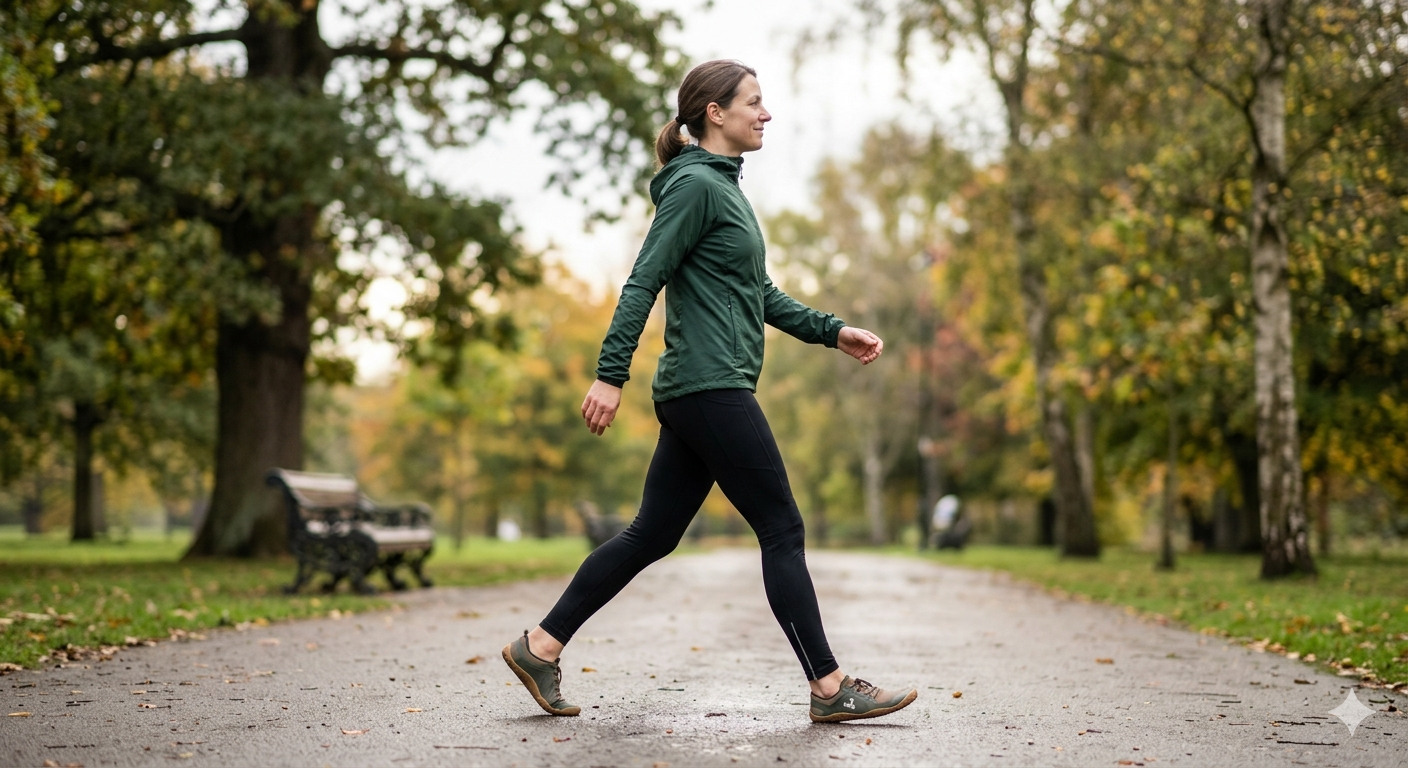
When your hips are stiff from a lack of walking, they lose their ability to extend (as seen in the image below). When your trailing leg can't push back, your body has to find that motion elsewhere to complete the stride.
It finds it in your lower back.
Instead of your hip joint moving, you end up "hinging" at your lumbar spine with every single step. This is why "back pain" is rarely just a back problem—it is frequently a hip mobility problem caused by insufficient walking volume. By hitting that 6-hour movement window, you take the pressure off your spine and allow your hips to do the job they were hired for.
Walking is "The Great Integrator"
This is where all our previous movement pillars come together. Walking is how you "train" the systems we've been discussing:
The Feet: If you walk in barefoot shoes, your feet can "feel" the ground, which sends data to your brain that allows your hips to relax and move more efficiently.
The Core: Forget about doing endless planks. A natural, efficient walk requires a subtle, rhythmic "reflexive" core contraction. The act of walking is core training.
The Posture: Walking breaks the "stagnation" of sitting. It resets your pelvis from an Anterior Pelvic Tilt and forces your head to balance neutrally on your shoulders.
How to Get Closer to 6 Hours (Without Quitting Your Job)
Reaching high movement volumes in the UK, especially with our unpredictable weather, requires a strategy. Here is how to "sneak" movement into your British workday:
1. The "Phone Pace"
Never sit during a phone call. If you are on your mobile, walk around the room. If you are on a team call where you don't need to be on camera, use a wireless headset and pace.
2. The 1km Rule
If your destination is less than 1km away, vow to walk it. Whether it's the local Co-op or the post box, those 10-minute bursts add up very quickly.
3. "Movement Snacks" Over "Workouts"
Instead of one massive, tiring walk, try three 15-minute walks: one before work, one at lunch, and one after dinner. Research shows this is actually better for blood sugar regulation and joint stiffness than one long slog.
4. Create a "Commute" (Even if you WFH)
If you work from home, walk "to work" by going around the block before you open your laptop. Do the same at the end of the day. This creates a psychological and physical boundary that protects your hips from the "all-day sit."
The Bottom Line: Motion is Lotion
Your hips aren't "old" and they aren't "broken." They are likely just "thirsty" for movement. Walking is the most accessible, low-cost, high-reward habit you can adopt for your long-term health.
Don't worry if you don't hit 6 hours tomorrow. Start by noticing how much you sit, and look for the "gaps" where you can stand, pace, or stroll. Your hips are the engine room of your body—keep them moving, and the rest of your body will follow.
Q&A: Walking & The 6-Hour Rule
-
A: 10,000 steps is a great baseline, but it’s a bit of an arbitrary number. For a typical person, 10,000 steps takes about 90 minutes. While that’s brilliant, it still leaves a huge portion of the day sedentary. The 6-hour rule includes standing, pacing, and pottering—basically, any time you aren't "parked" in a chair. Focus less on the step count and more on how often you "reset" your posture.
-
A: This is often a sign that your hips are stiff and your back is "over-working" to compensate. Try shortening your stride slightly and focusing on pushing off with your back foot rather than reaching forward with your front foot. Also, check your footwear—if you’re in heavy, cushioned shoes, your back might be taking the impact that your feet should be absorbing.
-
A: Standing is definitely better than sitting because it keeps your hip flexors long and your core "active," but it’s still static. The real magic happens when you move. If you have a standing desk, try shifting your weight from side to side, doing calf raises, or taking a "lap of the house" every 30 minutes.
-
A: Absolutely not. In fact, your body prefers it if you don't. The "6-hour rule" is about cumulative movement. Think of it as a "movement bank account"—ten minutes here, twenty minutes there. Breaking it up into small "movement snacks" throughout the day is actually better for managing blood sugar and joint stiffness than doing one massive trek and then sitting for the rest of the day.
-
A: Yes! Any time spent on your feet counts. However, don't let a hard gym session become an excuse to be a "couch potato" for the remaining 23 hours. The goal is to bridge the gap between "exercise" and "daily life."
-
A: We’ve all been there! On those rainy days, you have to get creative. Pace while you're on the phone, do some "housework sprints," or follow a 10-minute indoor mobility flow. Even walking up and down your stairs a few extra times counts toward your total volume.