
The Protein Puzzle: Why Everyone is Banging On About It (And How Much You Actually Need)
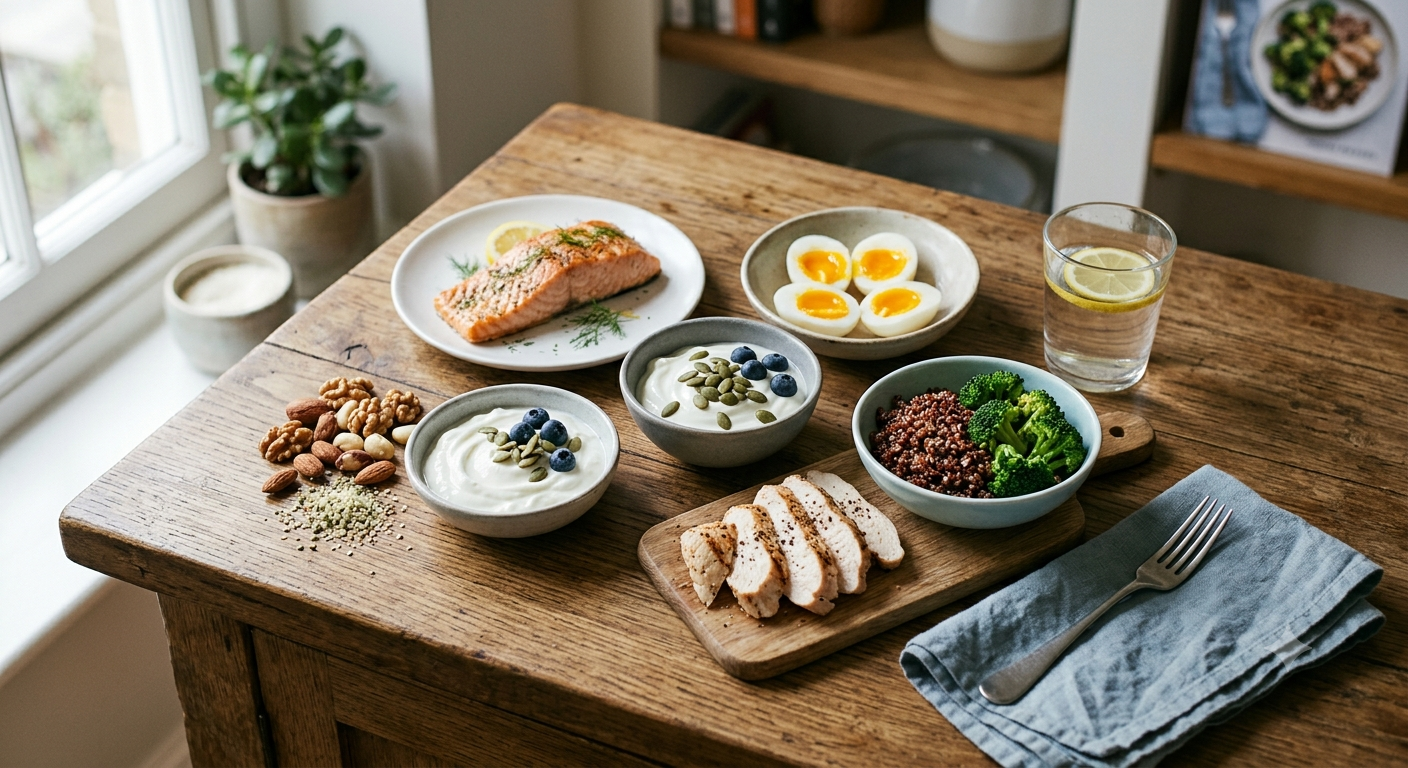
Building blocks on a plate. Hitting your daily protein target is easiest when you focus on high-quality, whole foods like lean meats, fish, eggs, and rich dairy.
If you’ve spent any time on social media, stepped into a local gym, or strolled down the yoghurt aisle of a UK supermarket lately, you’ll have noticed a massive trend. Everything, it seems, is now "high protein". From puddings to sliced bread, protein is being marketed as the golden ticket to health.
But is it all just clever marketing, or is there genuine science behind the hype?
I’m here to tell you that the hype is entirely justified. Protein is not just for bodybuilders looking to bulk up. If your goals are losing body fat, staying free from injury, or ensuring you can climb stairs and carry your own shopping when you’re 80, protein is your best friend.
Let's strip away the gym jargon and look at why protein is the ultimate lever for weight loss, muscle mass, and longevity—and calculate exactly how much you need.
1. The Weight Loss Weapon: The Thermic Effect and Fullness
When people decide to lose weight, their instinct is usually to eat less of everything. But simply starving yourself leads to a miserable cycle of hunger, muscle loss, and eventual rebound weight gain.
If you want to lose weight sustainably, you have to prioritise protein. It works through two powerful mechanisms:
The Saturation Factor (Satiety)
Protein is the most filling macronutrient. It triggers the release of satiety hormones (like peptide YY and GLP-1) while suppressing ghrelin, your "hunger hormone". If you start your morning with eggs or a Greek yoghurt bowl instead of toast, you will naturally crave fewer biscuits with your 11 a.m. tea. It physically keeps you fuller for longer.
The Thermic Effect of Food (TEF)
Did you know that digestion actually burns calories? This is called the Thermic Effect of Food.
When you eat fats or carbohydrates, your body uses about 5% to 15% of those calories just to digest them.
When you eat protein, your body has to work incredibly hard to break down those complex amino acid chains. It uses 20% to 30% of the protein's calories just to process it.
Essentially, a quarter of the calories from protein are burned off simply by eating it. It’s the closest thing we have to a metabolic "free lunch".
2. Muscle Mass: The Shield That Keeps You Young
As we discussed in our post on strength training, we naturally lose muscle mass as we age (a process called sarcopenia). From our 30s onwards, we can lose up to 8% of our muscle mass per decade if we do nothing to stop it.
Muscle is your biological currency. It is what keeps your joints safe, your posture upright, and your metabolism high.
To build or even just maintain muscle, your body needs two stimuli:
Mechanical tension (lifting heavy things).
Amino acids (the building blocks from dietary protein).
If you train hard in the gym but don't eat enough protein, your body cannot repair the micro-tears you created. Instead of getting stronger, you simply break your body down. Protein is the brick and mortar; training is the builder. Without the bricks, the builder can't build the house.
3. Longevity: Protecting Your "Healthspan"
We often think of protein in terms of how we look in the mirror next weekend. But the real magic of protein happens decades down the line.
As we get older, our bodies suffer from something called Anabolic Resistance. This means a 70-year-old body is much less efficient at turning dietary protein into muscle tissue than a 20-year-old body.
To stay strong, prevent falls, and maintain functional independence in later life, older adults actually need more protein relative to their body weight than young adults. Maintaining muscle mass into your 70s and 80s is one of the strongest predictors of survival after an illness or a fall. If you want to add healthy, active years to your life, you must keep your muscles fed.
4. Let's Talk Numbers: How Much Do You Actually Need?
Now, let's address the big question: How much do you need?
A Quick Correction: You might have heard a number like "1.6" thrown around. Just to save your bank balance and your digestive system—it's 1.6 grams per kilogram of bodyweight, not 1.6 kilograms! (Eating 1.6kg of protein a day would mean consuming about 25 ribeye steaks daily, which would certainly make your local butcher very happy, but would be physically impossible to digest!)
The NHS baseline recommendation is roughly 0.75g of protein per kilogram of body weight per day for sedentary adults. However, if you are active, lifting weights, or trying to lose weight, this baseline is far too low.
The Sweet Spot: 1.6g to 2.0g per Kilogram
The scientific consensus for active individuals, those wanting to drop body fat, or those focused on healthy ageing is 1.6 to 2.0 grams of protein per kilogram of body weight.
Let's do some quick maths to see what this looks like in the real world:
If you weigh 70kg:
$70 \times 1.6 = 112\text{g of protein per day}$
If you weigh 85kg:
$85 \times 1.6 = 136\text{g of protein per day}$
(Note: If you prefer calculating in stone, just divide your weight in pounds by 2.2 to get your weight in kilograms first!)
What does this look like on a plate?
Getting 120g of protein can feel daunting if you aren't used to it. Here is a simple, realistic day of eating to hit that target:
Breakfast: 3 scrambled eggs and a scoop of Greek yoghurt (~35g protein)
Lunch: A large chicken breast salad with pumpkin seeds (~40g protein)
Post-Workout: A high-quality whey or plant protein shake (~25g protein)
Dinner: A salmon fillet with broccoli and quinoa (~35g protein)
Total: ~135g of protein.
The Bottom Line: Feed Your Armour
Protein isn't a magic fat-burner, and it won't make you wake up looking like an Olympic weightlifter overnight.
What it will do is make your weight loss efforts twice as easy, ensure the hard work you put in at the gym actually results in stronger muscles, and build a resilient body that is prepared for the long haul.
Stop treating protein as an optional extra for athletes. It is the literal foundation of human structure. Feed your muscles, protect your joints, and invest in your future independence.
Q&A: Your Protein Questions Answered
Q: Can you eat too much protein? Will it damage my kidneys? A: For healthy individuals with normal kidney function, high protein diets (even up to 2.2g per kg) have been proven entirely safe. The myth that protein damages kidneys comes from medical settings where people with pre-existing kidney disease had to limit protein. If your kidneys are healthy, they are perfectly capable of filtering the protein you eat.
Q: Can I get enough protein on a vegan or vegetarian diet? A: Absolutely, though it requires a bit more planning. Plant proteins (like beans, lentils, tofu, and tempeh) are often lower in certain essential amino acids and are less calorie-dense in terms of pure protein than animal sources. Vegetarians can easily use eggs, cottage cheese, and Greek yoghurt, while vegans can benefit from combining different plant proteins (like rice and beans) or using a quality plant-based protein powder to hit their daily targets.
Q: Do I need to drink protein shakes? A: No, shakes are not mandatory. They are simply a convenient, cost-effective tool. It is always better to get your protein from whole foods (meat, fish, eggs, tofu) because they contain vital micronutrients. However, if you are struggling to hit your target of 1.6g per kg through food alone, a scoop of quality whey or vegan protein powder in your oats or a shaker is an incredibly easy way to close the gap.
Q: Do I have to eat protein immediately after my workout? A: The "30-minute anabolic window" is largely a myth. While it's a great habit to have a protein-rich meal or shake within a couple of hours of training, the most important factor by far is your total protein intake across the entire day. Don't stress about rushing to drink a shake in the gym changing rooms; just focus on hitting your daily target consistently.