
The Breathing Paradox: Why the Way You Breathe is Ruining Your Lifts (and Stiffening Your Neck)
As human beings, we perform one movement roughly 20,000 times a day. We do it without thinking, from the moment we are born to the moment we die.
That movement is breathing.
Because we do it automatically, we assume we must be doing it correctly. But if you spend your day working a desk job in the UK, plagued by a chronically stiff neck, or if you find yourself losing your balance and stability during a heavy squat in the gym, I have a surprising diagnosis for you: You’ve forgotten how to breathe.
To understand what went wrong, we only have to look at a sleeping baby.
If you watch an infant breathe, their chest stays completely still. Instead, their abdomen expands and contracts 360 degrees like a balloon. They aren't "tummy breathing"—they are diaphragmatic breathing. It is a perfect, built-in system for spinal stability.
Yet, somewhere between starting school and sitting at an office desk, we traded this masterpiece of biomechanics for a shallow, stressful, upper-chest pant.
Here is why your modern breathing habit is holding you back in the gym, locking up your neck, and how to reclaim your natural blueprint.
1. The Anatomy of a Modern Breather
Your primary breathing muscle is the diaphragm, a dome-shaped muscle that sits right beneath your lungs. When you inhale properly, the diaphragm drops down into your abdominal cavity. This creates a vacuum that pulls air into the lungs, while simultaneously creating pressure in your midsection.
However, modern life fights this process.
We live in a culture that tells us to "suck our stomachs in" for aesthetics. We sit in chairs that slouch our ribcages down toward our hips. Over time, the brain decides it’s too hard to push the diaphragm down against a tight, sucked-in belly.
So, it finds a workaround. It starts using the secondary breathing muscles—the small muscles in your neck and upper chest (like your scalenes and upper trapezius) to physically pull your ribcage up to get air in.
Imagine doing 20,000 mini-shrugs every single day. Is it any wonder your neck feels like concrete by 5 p.m.?
2. Why "Chest Breathing" Locks Up Your Neck
If you are a chest breather, your neck muscles are working overtime. They were designed to act as an emergency backup system—for when you are sprinting away from danger or gasp for air. They were never meant to carry the daily workload of respiration.
When you use your neck to breathe, these muscles become chronically tight, hypertonic, and fatigued.
People spend hundreds of pounds on sports massages, acupressure mats, and neck stretchers trying to release their upper traps. But if you walk out of a massage clinic and immediately take 20,000 shallow chest breaths, the tension will return before you’ve even reached your car.
To fix a tight neck, you have to stop treating the neck and start re-educating the diaphragm.
3. The Gym Secret: Breathing Is Core Stability
In the gym, we are obsessed with "core stability." We buy lifting belts, we do planks, and we try to "brace" our abs. But true core stability is impossible without proper breathing mechanics.
Think of your midsection as a fizzy drink can. The top of the can is your diaphragm, the bottom is your pelvic floor, and the sides are your abdominal muscles.
If the can is full and sealed, you can stand on top of it and it won't crush. That is Intra-Abdominal Pressure (IAP).
When you take a proper diaphragmatic breath before a heavy squat or deadlift, your diaphragm drops, creating immense internal pressure that stabilizes your spine from the inside out.
If you chest-breathe under a heavy barbell, the "top of the can" lifts up. The internal pressure drops, the can buckles, and your lower back or knees have to take the load. Learning to breathe into your lower abdomen is the single best injury-prevention tool you can deploy in the gym. It turns your core into stone without you needing to do a single sit-up.
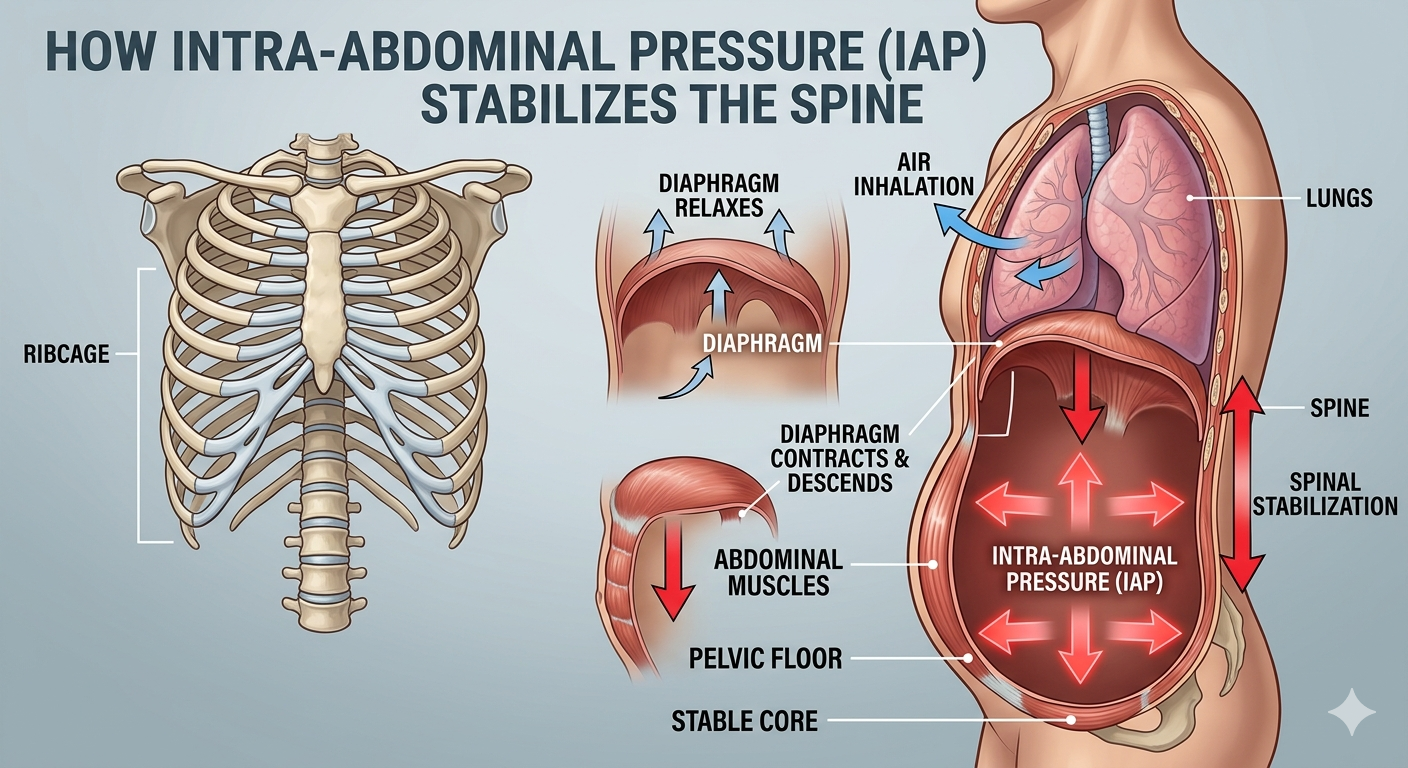
Figure 1: The anatomy of a functional breath. When the diaphragm contracts and moves downwards, it creates a hydraulic cylinder of internal pressure against the spine, supported by the abdominal wall and pelvic floor. This dynamic cylinder is what protects your lower back during heavy lifts.
4. Reclaiming the Infant Blueprint: How to Re-train Your Breath
You don’t need to learn a new skill; you just need to remember an old one. Here is how to take breathing out of your neck and put it back into your core:
The Crocodile Breath Test
Lie face down on the floor (on a comfortable mat) with your forehead resting on your stacked hands. Relax your legs.
As you inhale through your nose, focus on pushing your belly down into the floor, feeling your lower back and sides expand outwards.
Your chest and shoulders should remain completely relaxed against the ground.
If your shoulders shrug up toward your ears, you are chest-breathing. Practice this for 3 minutes before your next gym session to "wake up" the diaphragm.
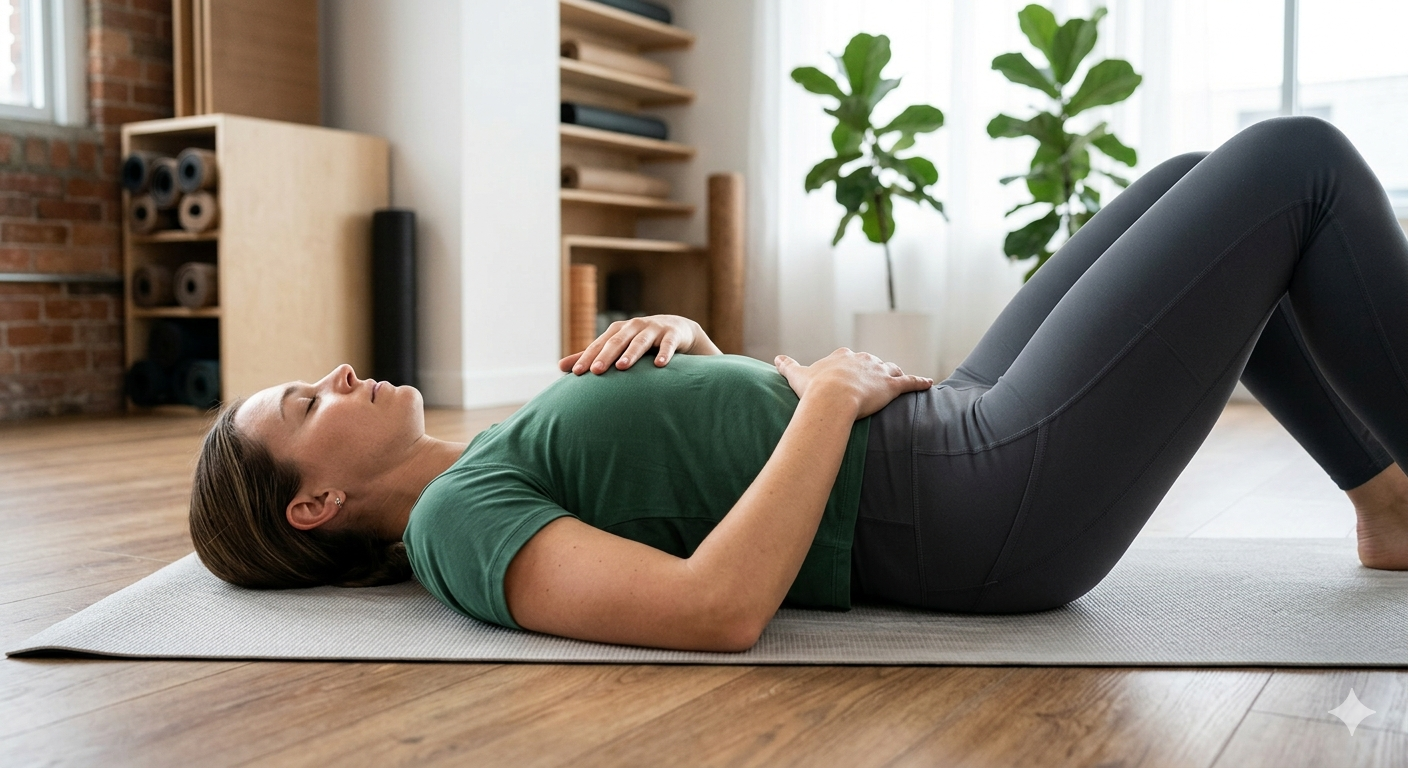
Figure 2: Practising diaphragmatic breath control. Lying down allows the neck and shoulder muscles to completely relax, making it easier to isolate the movement of the diaphragm and feel the lower abdomen expand. This is a progression of crocodile breathing.
The 360-Degree Expansion
When you are sitting at your desk, place your hands around your waist, just above your hips, with your fingers pointing forward and thumbs wrapped around your back.
Inhale and try to push your fingers and thumbs outwards in all directions.
You shouldn't just breathe into the front of your belly; you should feel your sides and lower back expand, too.
The Bottom Line: Breathe Better, Move Better
We spend a lot of time optimizing our nutrition, our gym routines, and our sleep. Yet we consistently ignore the one movement we perform more than any other.
If you want to unlock true power under the barbell, and if you want to finally rid yourself of that persistent neck stiffness, you have to look down. Stop breathing with your throat and start breathing with your core. Return to the natural mechanics you used perfectly as a child, and watch how quickly your body rewards you.
Q&A: Breathing, Stability & Neck Tension
Q: Should I breathe through my nose or my mouth during daily life? A: Nose, always. Your nose is designed for filtering, warming, and humidifying air, and nose breathing naturally engages the diaphragm. Mouth breathing keeps the nervous system in a "fight-or-flight" state and promotes shallow upper-chest breathing, which triggers that neck stiffness we talked about. Save mouth breathing for the very highest intensities of exercise.
Q: How should I breathe when I am performing a heavy lift in the gym? A: For heavy lifts (like a squat or deadlift), use the Valsalva Manoeuvre. Take a deep diaphragmatic breath into your belly (expanding 360 degrees), brace your core as if you are about to be punched in the stomach, perform the difficult part of the lift, and exhale sharply after you have passed the hardest point. This creates maximum structural stability for your spine.
Q: Can breathing properly really fix my neck pain permanently? A: If your neck tightness is caused by "accessory muscle breathing" (using your neck to pull up your ribcage), then yes. Until you take the daily workload off those small neck muscles, stretching or massaging them will only provide temporary relief. Correcting your breathing mechanics cuts off the root cause of the tension.
Q: I try to belly breathe, but my chest still moves first. How can I fix this? A: It takes practice to undo years of office-chair habits. Start by practicing while lying on your back with one hand on your chest and one hand on your stomach. Work on keeping the chest hand completely still while making the stomach hand rise and fall. Be patient—your brain is rewriting a motor pathway.